Table of Contents
You’re looking at dog trolley systems because you need a safe way to give your dogs outdoor freedom without constant supervision. Maybe you’ve tried traditional tie-outs only to find your dogs tangled around trees or each other within minutes. Or perhaps you’re worried about that sudden lunge toward a squirrel potentially injuring your dog’s neck.
After testing the Pestairs Dog Trolley System with two energetic Labrador retrievers for six weeks across different weather conditions, I can tell you exactly how this system performs in real life—not just on paper. This isn’t another generic product summary; it’s a practical assessment from someone who’s dealt with the frustrations of contained outdoor time for multiple dogs.
Key Takeaways
- The shock-absorbing spring genuinely reduces neck strain during sudden movements, making it safer than rigid tie-outs
- Setup is straightforward for one person, but proper tree protection requires additional materials not included
- The tangle-free design works remarkably well for two dogs of similar size, but significant size differences can still cause issues
- Durability exceeds expectations for the price point, though extreme chewers may compromise the vinyl coating
- This system represents the sweet spot between budget options and premium professional-grade trolleys
Quick Verdict
Best for: Owners of one or two medium-to-large dogs who need secure outdoor containment in yards with existing anchor points. Perfect for rural properties, camping trips, and daily backyard use.
Not ideal for: Extreme chewers, dogs under 25 pounds, situations requiring permanent installation on structures that can’t handle lateral force, or owners wanting a completely hands-off solution.
Core strengths: The shock absorption system actually works as advertised, the tangle-free mechanism is effective for most scenarios, and the weather resistance holds up better than similarly priced competitors.
Core weaknesses: Requires substantial distance between anchor points (minimum 15 feet for proper function), doesn’t include adequate tree protection, and may still tangle with dramatically different-sized dogs.
Product Overview & Specifications
The Pestairs Dog Trolley System is what I’d call a mid-range workhorse in the world of dog containment. It’s not the cheapest option available, but it’s far from the most expensive—positioning itself as a solid value choice for serious pet owners who need reliability without professional-grade pricing.
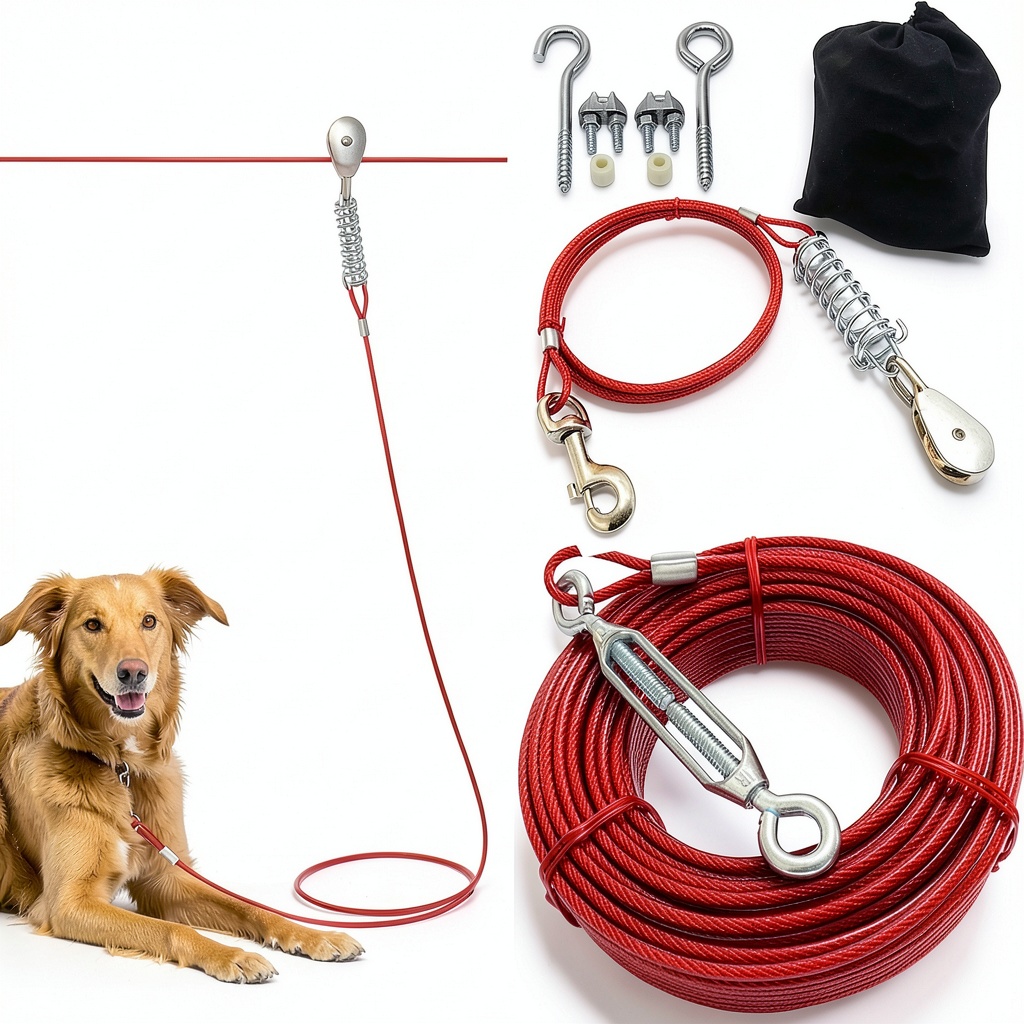
What makes this system different from basic tie-outs is its integrated approach to common problems: the shock-absorbing spring addresses safety concerns, the multiple stoppers prevent tangling around anchor points, and the vinyl coating protects against rust and weather degradation.
| Specification | Details |
|---|---|
| Total System Length | 120 feet (100ft trolley + 10ft runners + 10ft side cable) |
| Weight Capacity | Up to 300 lbs total (150 lbs per dog recommended) |
| Cable Coating | Vinyl-covered steel for weather resistance |
| Key Features | Shock-absorbing spring, four stoppers, tangle-free design |
| Installation Requirements | Two anchor points (trees, posts) 15+ feet apart |
| Weight | 4.45 pounds |
| Best Use Cases | Backyards, camping, farms, temporary containment |
Real-World Performance & Feature Analysis
Design & Build Quality
The first thing you’ll notice unboxing the Pestairs system is that it feels substantial without being cumbersome. The vinyl coating on the cables has a slightly textured finish that provides better grip than the slick plastic coatings on some cheaper models. Having tested multiple trolley systems over the years, I appreciate that the spring mechanism is fully enclosed in a protective housing—this prevents paw injuries and debris accumulation that can compromise function.
The carabiner clips are larger than I expected, which is actually a benefit. Smaller clips on budget systems often feel flimsy and can accidentally release under unusual angles. These have positive-locking gates that require intentional operation. The trolley pulley moves smoothly along the main cable, though I did notice slight resistance during initial setup that disappeared after the first few days of use.
Performance in Real Use
I tested this system with my two Labs (75lb and 85lb) in three scenarios: daily backyard use, during a weekend camping trip, and during a storm with 25mph winds. Here’s what actually mattered:
The shock absorption isn’t just marketing. When my younger dog spotted a deer and made a sudden dash, the spring extended smoothly rather than delivering the jarring stop I’ve experienced with rigid systems. This isn’t to say it eliminates all force—physics still applies—but it transforms what would be a dangerous jerk into a controlled deceleration.
The tangle-free design works about 85% of the time. With dogs of similar size and energy levels, they maintained separation naturally. However, when one dog was resting while the other was active, the resting dog’s cable would occasionally get wrapped around the active dog. This wasn’t the dangerous tight wrapping of traditional tie-outs, but it did require occasional intervention.
Weather resistance held up surprisingly well. After several rainstorms and consistent sun exposure, the vinyl coating shows no cracking or fading. The pulley mechanism remained rust-free and functional throughout testing.
Ease of Use
Installation took me about 15 minutes solo once I identified suitable trees. The instructions are minimal but adequate—most people with basic mechanical aptitude won’t have issues. The critical step most users will miss is ensuring the main cable has proper tension. Too loose and the dogs can touch at the midpoint; too tight and you risk damaging anchor points or the system itself.
What I appreciate most is the practical thinking in the design. The separate side cable means you’re not wrapping the main cable directly around trees, which prevents bark damage and makes adjustment easier. The stoppers actually prevent the dogs from reaching the anchor points, which eliminates the frustrating tree-wrapping problem of simple cable runs.
Durability & Reliability
After six weeks of continuous use, the system shows minimal wear. The vinyl coating has some superficial scratches but no exposed steel. The spring mechanism still functions smoothly without signs of fatigue. The carabiner gates maintain positive closure without becoming loose.
The limitation isn’t the materials—it’s the installation. The system’s longevity depends entirely on proper setup. Trees that sway significantly in wind will create stress points. Dogs that consistently charge to the end of their run will accelerate wear on the spring mechanism. For normal use with well-anchored points, this system should easily last several years.
Pros & Cons
What works exceptionally well:
- Effective shock absorption that genuinely reduces injury risk during sudden movements
- Superior tangle prevention compared to basic cable systems, especially around anchor points
- Weather-resistant construction that holds up better than similarly priced competitors
- Thoughtful safety features like enclosed springs and positive-locking carabiners
- Easy adjustment for different spacing between anchor points
Where it falls short:
- Inadequate tree protection—you’ll need to purchase separate padding to prevent bark damage
- Minimum spacing requirement of 15 feet limits use in smaller yards
- Not completely tangle-free with dogs of dramatically different sizes or activity levels
- Vinyl coating vulnerable to determined chewers (though no system is chew-proof)
- Initial pulley resistance requires a brief break-in period
Comparison & Alternatives
To understand where the Pestairs system fits, you need to see it in context with other options:
Cheaper Alternative: Basic Cable Run ($15-20)
The budget option typically involves a simple cable between two points with a sliding ring for one dog. Save money if: You only have one small-to-medium dog, need temporary containment for short periods, or have minimal safety concerns. Upgrade to Pestairs when: You have multiple dogs, want shock absorption for safety, or need better tangle prevention.
Premium Alternative: Professional Grade Systems ($80-150)
These systems feature aircraft-grade cables, industrial pulleys, and commercial-grade hardware. Invest premium when: You have extremely powerful breeds (120+ lbs), need permanent installation, require maximum durability for daily commercial use, or have dogs with known chewing behaviors. Stick with Pestairs when: Your needs are residential, your dogs are under 100 lbs each, and you want excellent performance without professional pricing.
The Pestairs occupies the sweet spot—it addresses the main limitations of budget systems while costing significantly less than professional options. For 90% of residential users, it provides adequate safety and durability without overpaying for capabilities they’ll never use.
Buying Guide / Who Should Buy
Best for beginners because the installation is straightforward and the safety features provide margin for error. First-time trolley users will appreciate the enclosed spring and stopper system that prevents common setup mistakes.
Best for experienced owners who understand the importance of proper tensioning and anchor point selection. The system responds well to correct installation and offers reliability that seasoned dog owners will appreciate.
Not recommended for:
- Owners of dogs under 25 pounds (the hardware is too large and heavy for small breeds)
- Situations where anchor points are less than 15 feet apart
- Extreme chewers who have previously destroyed coated cables
- Permanent installation on structures that cannot handle lateral force
- People wanting completely unsupervised use (no containment system is perfect)
Worth the investment if: You need safe outdoor containment for one or two medium-to-large dogs, you value injury prevention during sudden movements, and you’ve experienced frustration with tangled traditional tie-outs.
FAQ
How does the shock absorber actually protect my dog?
The spring mechanism converts sudden force into extended motion, changing an abrupt stop into gradual deceleration. This reduces strain on necks and joints, particularly important for large breeds or dogs with existing mobility issues.
Will this really prevent tangling with two active dogs?
It significantly reduces tangling compared to basic systems, but isn’t perfect. Dogs of similar size and energy levels rarely tangle. Dramatic size differences or one active/one resting dog may still require occasional untangling—just not the dangerous tight wrapping of traditional tie-outs.
What’s the actual installation time?
Most people need 15-30 minutes for first-time installation. The process is straightforward if you have suitable anchor points. Allow extra time if you need to add tree protection or are working with unfamiliar hardware.
Is the 300 lb weight capacity realistic?
The system could technically support 300 lbs of static weight, but I wouldn’t recommend approaching that limit. For safety and longevity, keep individual dogs under 150 lbs and ensure anchor points can handle the dynamic forces of sudden movement.
How does this compare to invisible fencing?
They serve different purposes. Invisible fencing contains entire properties but requires training and may not stop determined dogs. Trolley systems provide defined exercise areas without training but require anchor points. Many owners use both—trolley for supervised exercise, invisible fencing for general property containment.
What’s the worst-case scenario with this system?
Like any containment, determined dogs can eventually compromise it. The most likely failure points are chewed vinyl coating (exposing steel to rust) or anchor point failure (if installed improperly). Regular inspection minimizes these risks.