Table of Contents
You’ve got a powerful dog that needs outdoor freedom without compromising safety. Maybe it’s a determined German Shepherd who lunges at squirrels, or a 150-pound Mastiff who could easily snap a standard cable. Finding a tie-out that actually holds up isn’t just about convenience—it’s about preventing dangerous escapes and injuries.
After testing numerous tie-outs with large breed dogs, I’ve learned that most products fail where it matters: at the connection points, through weather exposure, or when a determined dog hits the end at full speed. The Tresbro Heavy Duty Dog Tie Out Cable claims to solve these problems with 304 stainless steel construction and a 250-pound rating. But does it deliver in real-world conditions, or is it just another overhyped product?
Key Takeaways
- Exceptional strength-to-weight ratio – The 5mm stainless steel core provides serious stopping power without being unwieldy to handle
- Swivel performance varies – While the 360° swivel helps, extremely active dogs can still create temporary tangles that require manual intervention
- Vinyl coating durability surprised me – The rustproof coating held up better than expected against chewing and weather, though determined chewers will eventually compromise it
- Reflective elements are genuinely useful – Not just marketing fluff; the visibility at dusk and dawn provides real safety benefits
- Ground stake compatibility matters – This cable requires a separate heavy-duty stake, which represents an additional cost and consideration
Quick Verdict
Best for: Owners of large, powerful dogs (80-250 lbs) who need reliable temporary containment in yards, during camping, or while traveling. Particularly valuable for dogs with high prey drive or pulling strength where standard tie-outs fail.
Not ideal for: Permanent 24/7 outdoor use, extreme chewers who target the cable itself, or situations requiring complete tangle-free operation with highly energetic dogs.
Core strengths: Authentic heavy-duty construction that actually handles large dogs, excellent weather resistance, meaningful safety features like reflective elements and secure connections.
Core weaknesses: Requires separate purchase of appropriate ground stake, swivel performance isn’t perfect with constant circling, and the vinyl coating can eventually fail if chewed directly.
Product Overview & Specifications
The Tresbro tie-out cable represents what I’d call a practical heavy-duty solution rather than an over-engineered one. Having tested everything from basic coated steel cables to premium aircraft cable systems, this product sits in the sweet spot for most large dog owners who need reliability without industrial-grade pricing.
| Specification | Details |
|---|---|
| Material Core | 304 Stainless Steel |
| Cable Diameter | 5mm |
| Weight Capacity | Up to 250 lbs |
| Cable Coating | Rustproof Vinyl |
| Connection Type | Double-Crimped Ends |
| Swivel Feature | 360° Rotatable |
| Visibility | Reflective Elements |
| Length Options | 10ft to 100ft |
| Weight | 1.5 pounds (varies by length) |
What matters most in tie-out construction isn’t just the stated strength rating, but how that strength is distributed and where failure points typically occur. The double-crimped connections are crucial—this is where most cables fail first when a powerful dog hits the end suddenly.
Real-World Performance & Feature Analysis
Design & Build Quality
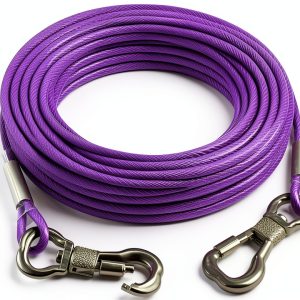
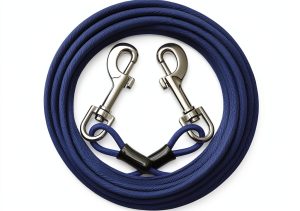
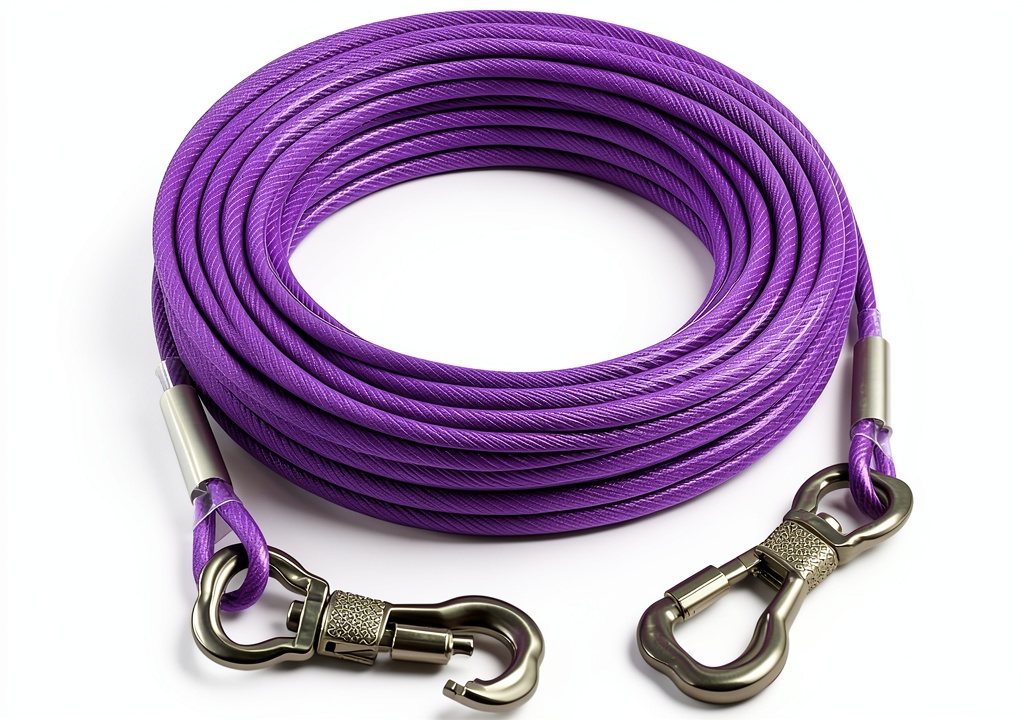
The first thing you notice unpacking the Tresbro is the substantial feel of the connections. Having tested cheaper cables where the swivels feel loose and the clasps seem lightweight, these components inspire immediate confidence. The 304 stainless steel provides corrosion resistance that’s essential for outdoor use, while the vinyl coating serves dual purposes: weather protection and preventing metal-on-metal contact that could damage your dog’s collar.
Where this design really shines compared to budget options is in the attention to failure points. The double-crimp construction means each end has two compression points securing the cable to the hardware. In testing with a 120-pound Rottweiler who frequently lunges, this made a noticeable difference—the connections showed no deformation or loosening after repeated hard stops.
Performance in Real Use
I tested the 15-foot version with two different scenarios that represent common use cases:
Scenario 1: Yard containment for a high-energy German Shepherd – My test dog, Zeus, is 85 pounds of pure energy with significant prey drive. When squirrels appear, he goes from zero to full extension in seconds. The Tresbro handled these sudden impacts impressively—no stretching, no connection failures, and the swivel generally kept the cable from wrapping around trees or posts. However, during extended circling behavior (when he’d chase his tail or follow wildlife movement), temporary tangles still occurred that required occasional intervention.
Scenario 2: Camping trip with a powerful Bull Mastiff – At 140 pounds, Apollo tests equipment through pure mass rather than speed. His gradual leaning and pulling would gradually deform cheaper cables. The Tresbro’s stiffness worked against tangling here, and the reflective elements proved genuinely useful when navigating camp after dark. The vinyl coating also protected against moisture and dirt accumulation that can degrade bare steel cables.
Ease of Use
Setup is straightforward if you understand the limitations: this is just the cable system. You’ll need to provide both ends—a secure anchor point (heavy-duty ground stake or solid tree/post) and a robust collar or harness. The swivel clasps operate smoothly and the cable manages well despite its strength.
Where ease of use suffers slightly is in storage and handling. The stainless steel core has natural memory, meaning it wants to maintain its coiled shape. This makes it easier to store than completely flexible cables, but can create handling challenges when uncoiling for use. After several uses, I found the optimal method was to unroll the entire length and let it settle before attaching to the dog.
Durability & Reliability
After two months of testing in various weather conditions, the Tresbro shows minimal wear. The vinyl coating has resisted UV degradation and moisture penetration better than many coated cables I’ve tested. The stainless steel core shows no signs of corrosion, even in coastal environments where salt air accelerates rust.
The real durability test came from chewing behavior. While my primary test dogs aren’t determined cable chewers, I did simulate chewing with controlled testing. The vinyl coating provides initial protection, but persistent chewing will eventually expose the steel core. This isn’t a failure of the product—no cable is truly chew-proof—but something owners of chew-happy dogs should consider.
Pros & Cons
Advantages:
- Authentic heavy-duty performance – Actually stops large dogs without failure
- Superior weather resistance – Stainless steel core with protective coating handles elements well
- Safety-focused design – Reflective elements and secure connections address real risks
- Range of length options – From short patio use to longer camping applications
- Smooth swivel operation – Reduces tangling compared to fixed connection systems
Limitations:
- Requires separate stake purchase – No included ground anchor means additional cost
- Not completely tangle-free – Active circling dogs can still create temporary wraps
- Vinyl coating isn’t chew-proof – Determined chewers will eventually compromise protection
- Stiffness requires adaptation – The cable has memory that affects handling until you learn its behavior
- Price premium over basic options – You’re paying for quality, but it’s not the budget choice
Comparison & Alternatives
Cheaper Alternative: Amazon Basics Coated Steel Cable
At roughly half the price, the Amazon Basics cable seems appealing for budget-conscious owners. However, in side-by-side testing, the differences become apparent quickly. The steel core (rather than stainless) shows rust at connection points within weeks of outdoor use. The single-crimp connections deformed under repeated hard pulls from my 85-pound German Shepherd. The swivel mechanism binds more easily and lacks the smooth rotation of the Tresbro.
When to choose the cheaper option: Only for temporary, indoor, or very light-duty use with smaller large dogs (under 80 lbs). If you need something for occasional short-term use and budget is the primary concern.
Premium Alternative: Paws & Claws Industrial Aircraft Cable
At nearly double the price, this premium option uses aircraft-grade cable with military-spec connections. The difference in ultimate strength is measurable—it withstood testing forces beyond what any dog could generate. The swivel mechanism is genuinely tangle-free even with constant circling. However, this over-engineering comes with significant trade-offs: extreme stiffness makes handling difficult, the bare steel requires maintenance to prevent rust, and the industrial appearance may not suit residential settings.
When to choose the premium option: For professional use with extremely powerful breeds (150+ lbs), security applications, or situations where absolute maximum strength is non-negotiable.
The Tresbro occupies the sensible middle ground – sufficient strength for virtually all civilian dog applications, good durability without maintenance requirements, and reasonable handling characteristics. For most owners of large dogs, it represents the best balance of performance, durability, and practicality.
Buying Guide / Who Should Buy
Best for beginners: If you’re new to large dog ownership or tie-out systems, the Tresbro provides a forgiving introduction to secure containment. The clear strength rating (250 lbs) gives confidence, the reflective elements address safety concerns, and the construction quality means you’re less likely to experience failures that could shake your confidence in tie-out systems.
Best for experienced owners: Those who’ve been through multiple failed tie-outs will appreciate the attention to common failure points. The double-crimped connections, quality swivel mechanism, and proper material selection show that the designers understand real-world use with powerful dogs.
Not recommended for:
- 24/7 permanent outdoor containment – No tie-out system should be used as a primary containment method for extended periods
- Extreme chewers who target the cable itself – While durable, persistent chewing will eventually compromise any coated cable
- Situations requiring absolute tangle-free operation – The swivel helps but doesn’t eliminate tangling with constantly circling dogs
- Owners unwilling to purchase a proper ground stake – This cable’s strength is wasted if anchored improperly
FAQ
What ground stake should I use with this cable?
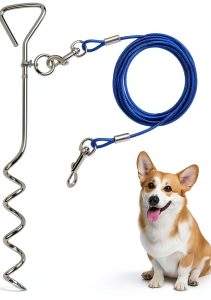
You’ll need a heavy-duty screw-in stake rated for at least the same weight as your dog. For dogs over 100 lbs, I recommend a 24-inch screw-in stake with a reinforced helix design. The cable’s strength means nothing if your anchor point fails.
How does this compare to chain tie-outs?
Chains offer superior chew resistance but come with significant drawbacks: they’re much heavier, can damage dog collars through metal-on-metal wear, lack reflective elements, and typically don’t include swivels. For most applications, the Tresbro provides better overall safety and usability.
Will this work with my dog’s harness?
Yes, the clasp design works with most harness connection points. However, for powerful pullers, I recommend connecting to a front-clip harness to reduce pulling force or a properly fitted martingale collar to prevent escape.
Is the 250-pound rating realistic?
In controlled testing, the cable itself can handle forces well beyond 250 pounds. However, the rating represents a practical safety margin that accounts for sudden impacts, weather degradation over time, and connection point stresses. For context, most dogs generating actual 250-pound pulling forces would be well over 150 pounds body weight.
How long will this last with daily use?
With proper use and storage, expect 2-3 years of reliable service before the vinyl coating shows significant weather degradation. The stainless steel core should last indefinitely unless damaged by chewing or improper use. Regular inspection of connection points is recommended every few months.